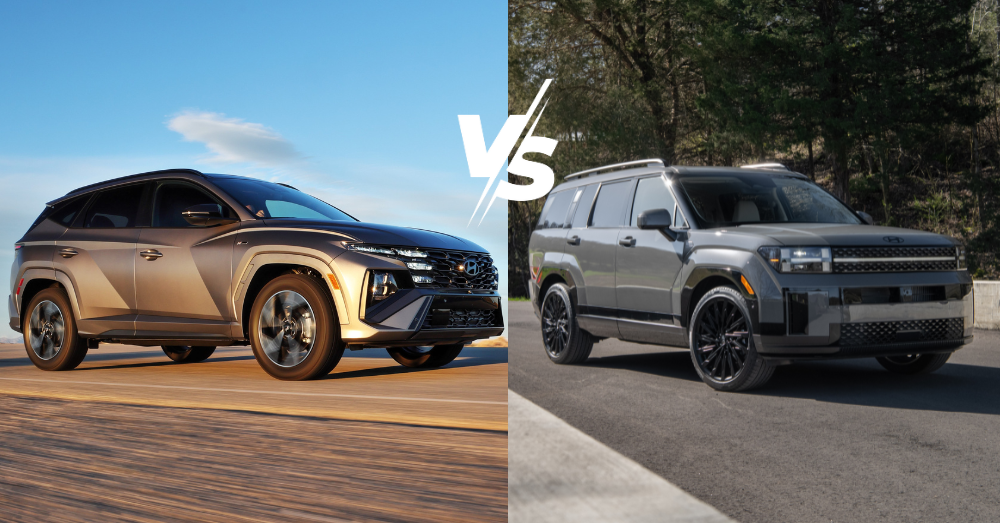



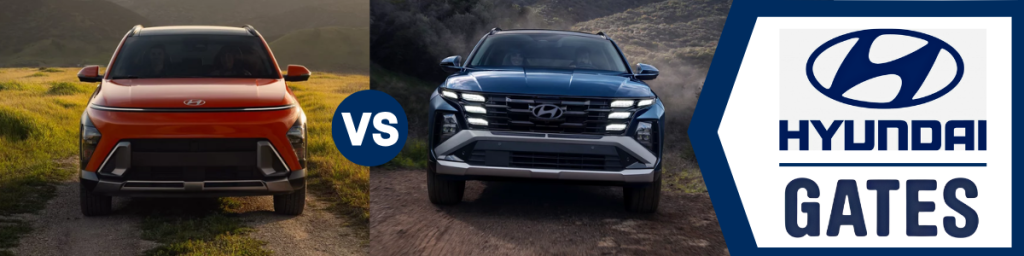
What Changes When You Step Up From Kona to Tucson Two Hyundai SUVs share a showroom floor, a grille family, and the same warranty paperwork. One tucks into a tight downtown spot with inches left over. The other holds a stroller, a cooler, and two duffel bags without anyone folding a seat. The Kona measures 171.3 inches long and holds 25.5 cubic feet behind the rear seats, while the Tucson stretches to 182.7 inches and holds 41.2 cubic feet. Kona shoppers pick between a 147-horsepower 2.0L and a 190-horsepower 1.6L turbo, and every gas Tucson trim runs the same 187-horsepower 2.5L. Front-wheel drive is standard on both models, with HTRAC all-wheel drive available on every trim in either lineup. What Separates a Small SUV From a Compact One Hyundai builds the Kona as a subcompact crossover and the Tucson as a compact, and those labels show up on the tape measure. The Kona rides on a 104.7-inch wheelbase and measures 171.3 inches long. Tucson adds almost a foot of length at 182.7 inches, riding on a 108.5-inch wheelbase. Cargo room follows the same pattern. Behind the rear seats, you get 25.5 cubic feet in a Kona and 41.2 in a Tucson. Drop both rear benches, and those numbers grow to 63.7 and 80.3 cubic feet. Anyone weighing Hyundai Kona vs. Tucson should think about parking, too. Kona swings around inside a 34.8-foot turning circle. Tucson needs 38.6 feet to do the same thing, which you feel in a crowded garage. Two Engines Split the Kona Lineup Kona SE and SEL Sport use a 2.0L four-cylinder rated at 147 horsepower at 6,200 rpm and 132 lb-ft of torque at 4,500 rpm, paired with an Intelligent Variable Transmission. Move up to SEL Premium or Limited, and a 1.6L turbo takes over, producing 190 horsepower at 6,000 rpm and 195 lb-ft between 1,700 and 4,500 rpm, through an eight-speed automatic with paddle shifters. That turbo changes the personality of the car on an on-ramp. Hyundai does not rate any Kona for towing. One Engine Runs Every Gas Tucson Shopping Tucson trims is simpler because the powertrain never changes. All six gas trims run a 2.5L four-cylinder rated at 187 horsepower at 6,100 rpm and 178 lb-ft at 4,000 rpm, backed by an eight-speed automatic with SHIFTRONIC. Your decision comes down to wheels, seats, and screens instead of speed. Tucson also pulls up to 2,750 pounds with trailer brakes, so a small utility trailer or a pair of jet skis stays on the table. Hybrid and plug-in hybrid Tucson models sit in their own lineups with separate pricing and mileage. Hyundai Kona vs. Tucson Trim by Trim Comparison Trim Starting MSRP Engine and Power EPA MPG (FWD) Wheels Added Features 2026 Hyundai Kona (Subcompact SUV) • 171.3 in. long • Cargo 25.5 cu. ft. behind the rear seats, 63.7 cu. ft. with them folded • Not rated for towing Kona SE $25,500 2.0L I4, 147 hp, 132 lb-ft, IVT 29 / 34 / 31 17-inch alloy 12.3-inch touchscreen, wireless Apple CarPlay and Android Auto, Idle Stop & Go, cloth seats, Smart Cruise Control with Stop & Go Kona SEL Sport $26,825 2.0L I4, 147 hp, 132 lb-ft, IVT 28 / 35 / 31 18-inch black finished alloy Heated front seats, wireless device charging, dual automatic temperature control, second-row air vents, leather-wrapped steering wheel Kona SEL Premium $28,425 1.6L turbo I4, 190 hp, 195 lb-ft, 8-speed automatic 26 / 31 / 28 19-inch N Line design alloy H-Tex trimmed seats, 8-way power driver seat, ambient interior lighting, paddle shifters, column-mounted shift-by-wire Kona Limited $32,535 1.6L turbo I4, 190 hp, 195 lb-ft, 8-speed automatic 26 / 31 / 28 19-inch alloy Ventilated front seats, Bose premium audio with 8 speakers, power sunroof, hands-free power tailgate, Surround View Monitor, Blind-Spot View Monitor 2026 Hyundai Tucson, Gas (Compact SUV) • 182.7 in. long • Cargo 41.2 cu. ft. behind the rear seats, 80.3 cu. ft. with them folded, or 38.7 and 74.8 by SAE measurement • Tows 2,750 lbs. with trailer brakes Tucson SE $29,700 2.5L I4, 187 hp, 178 lb-ft, 8-speed automatic 25 / 33 / 28 17-inch alloy 12.3-inch touchscreen, wireless Apple CarPlay and Android Auto, cloth seats, dual-level cargo floor, trailer pre-wiring Tucson SEL $31,050 2.5L I4, 187 hp, 178 lb-ft, 8-speed automatic 25 / 33 / 28 18-inch alloy Heated front seats, 8-way power driver seat with lumbar, hands-free smart liftgate, roof side rails, rear privacy glass Tucson SEL Plus $31,550 2.5L I4, 187 hp, 178 lb-ft, 8-speed automatic 25 / 33 / 28 19-inch alloy H-Tex trimmed seats, with the rest of the SEL equipment list carried over Tucson XRT $33,725 2.5L I4, 187 hp, 178 lb-ft, 8-speed automatic 25 / 33 / 28 18-inch XRT-exclusive alloy Standard tow hitch, Terrain Mode with HTRAC AWD, LED taillights, XRT side cladding, 64-color ambient lighting Tucson SEL Premium $34,050 2.5L I4, 187 hp, 178 lb-ft, 8-speed automatic 25 / 33 / 28 18-inch alloy 12.3-inch digital instrument cluster, onboard navigation, wireless phone charger, power tilt-and-slide sunroof, Highway Driving Assist 1 Tucson Limited $39,675 2.5L I4, 187 hp, 178 lb-ft, 8-speed automatic 25 / 33 / 28 19-inch alloy Leather-trimmed seats, panoramic sunroof, Bose premium audio, 12-inch head-up display, ventilated front and heated rear seats, Surround View Monitor HTRAC all-wheel drive is available on every trim shown. AWD ratings are 27/29/28 for Kona SE, 26/29/27 for Kona SEL Sport, 25/28/26 for both turbo Kona trims, and 24/30/26 for all gas Tucson trims. EPA estimates are for comparison purposes. Starting MSRP excludes freight charges, tax, title, and license fees. Fuel Economy and What Each Choice Costs You Kona SE earns EPA ratings of 29 city, 34 highway, and 31 combined with front-wheel drive, and the SEL Sport shifts that spread to 28/35/31 without Idle Stop & Go. Both turbo trims settle at 26/31/28. Every gas Tucson posts 25/33/28 with front-wheel drive, so a base Kona saves you three combined mpg while a turbo Kona ends up dead even with it. Adding all-wheel drive costs a few mpg on both, and the gap between them shrinks a little more. Matching the Right Size to Your Week Drivers who commute alone, park on the street, and haul groceries rarely run out of room in a Kona. Add car seats, a dog crate, camping gear, or a small trailer, and the Tucson earns its extra length fast. Price muddies things in the middle of both lineups, since a loaded Kona Limited sits close to a Tucson SEL Plus. Decide whether you would rather have ventilated seats and a Bose system in a smaller package or a cargo hold. The Hyundai Tucson rates at 41.2 cubic feet, compared with the Kona's 25.5. Why Buy Your Next Hyundai SUV From Gates Hyundai We stock both models in Richmond, so you can climb from a Kona into a Tucson on the same afternoon and feel the difference yourself. Sitting in each one answers questions no spec sheet can, like whether the Kona's back seat fits your kids or whether the Tucson's cargo floor swallows your golf bag. Our sales team walks through trim differences without steering you toward the biggest window sticker, and our finance staff works with a wide range of credit situations. Bring your trade, drive both, and let your own tape measure settle it.
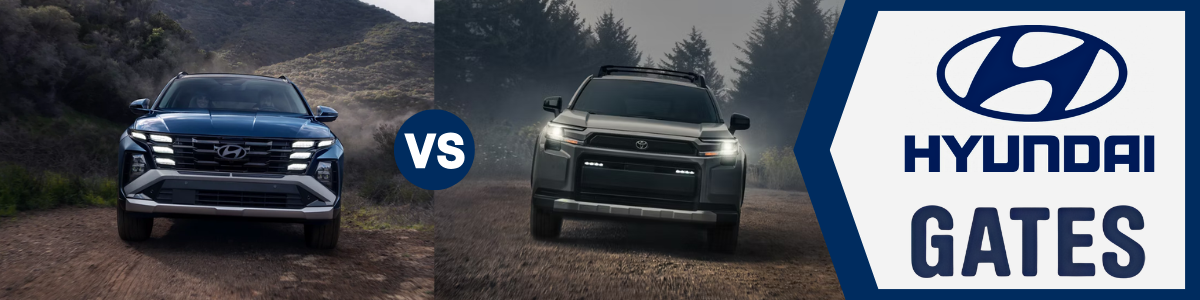
2026 Hyundai Tucson vs. Toyota RAV4: Why Tucson Is the Smarter Compact SUV Buy
Why the 2026 Tucson Stretches Your Dollar Further Than the RAV4 Park at any Kentucky grocery store and you'll count a dozen compact SUVs before you reach the door. Two names pop up again and again. This year's Toyota RAV4 is all-new and now comes only as a hybrid or plug-in hybrid, while the 2026 Hyundai Tucson lets you choose gas, hybrid, or plug-in power. Both are good SUVs, but the Tucson keeps more money in your pocket at almost every step of the trim ladder. The gas Tucson SE starts at $29,700, and the Tucson Hybrid SE starts at $31,300, both below the $31,900 RAV4 LE. Every Tucson gets a 12.3-inch touchscreen, and gas and hybrid models add more cargo room and a much longer powertrain warranty than the RAV4. The RAV4 fights back with better fuel economy and higher tow ratings, so your daily routine should guide the choice. Hyundai Tucson vs. Toyota RAV4 Pricing Starts in Your Favor Toyota dropped the gas engine from the RAV4 for 2026. Every model is now electrified, and the LE starts at $31,900. That's a fair price for a hybrid, but it means there's no cheaper way into a new RAV4. Hyundai still sells a gas Tucson. The SE starts at $29,700 with a 187-horsepower 2.5-liter engine, an eight-speed automatic, and 33 mpg on the highway with front-wheel drive. Want a hybrid instead? The Tucson Hybrid SE comes in at $31,300, and it is now offered with front-wheel drive as well as HTRAC. It makes 231 combined horsepower, a bit above the 226 horsepower in a front-drive RAV4. Line up the Hyundai Tucson vs. Toyota RAV4 trim by trim, and that pattern holds, with the Tucson bringing more gear for less cash. More Standard Gear on Every Rung The gap grows as you move up. A $32,750 Tucson Hybrid SEL already has heated front seats, an 8-way power driver's seat, 18-inch wheels, and a hands-free liftgate that opens when you stand near it with the fob in your pocket. In the RAV4, heated front seats first appear on the $34,700 SE, which is nearly $2,000 higher. Screens tell a similar story. Every Tucson has a 12.3-inch touchscreen. The RAV4 LE and SE use a 10.5-inch display, with a 12.9-inch screen standard on the XSE, Limited, and GR SPORT. Safety Tech You Don't Pay Extra For Hyundai SmartSense comes standard on every Tucson trim, including Forward Attention Warning, which watches for signs the driver has stopped paying attention to the road ahead. Here's how it works. Shop Tucson inventory Room for People and Gear Cargo space goes to the Tucson. Gas and hybrid models give you 38.7 cubic feet behind the rear seat, and gas models stretch to 74.8 cubic feet with the seat folded. Toyota lists up to 37.8 cubic feet behind the RAV4's second row. Back-seat riders get 41.3 inches of legroom in the Tucson, which helps when your teenager grows three inches over one summer. A Warranty Built for Long-Term Owners Hyundai backs the Tucson with a 5-year/60,000-mile new vehicle warranty and a 10-year/100,000-mile powertrain warranty. Toyota's coverage runs 3 years or 36,000 miles, with 5 years or 60,000 miles on the powertrain. Keep your SUV for the long haul, and that gap adds up. Hybrid batteries are a closer fight. Hyundai covers the Tucson's battery for 10 years or 100,000 miles, and Toyota covers the RAV4's for 10 years or 150,000 miles. That round goes to Toyota. Where the RAV4 Pulls Ahead Fair is fair. Toyota rates the front-drive RAV4 hybrids at 43 mpg combined, while the front-drive Tucson Hybrid SE and SEL are EPA-rated at 38 mpg combined. Select AWD RAV4 trims can tow 3,500 pounds. The gas Tucson tops out at 2,750 pounds with trailer brakes, and the hybrid is rated for 2,000. Plug-in shoppers should know the RAV4 PHEV makes 324 horsepower, and Toyota estimates up to 52 miles of electric range on the SE. The Tucson Plug-in Hybrid produces 268 horsepower and offers a 32-mile electric range. Picking the Right Tucson for Your Budget If you tow a camper or chase every last mile per gallon, the RAV4 deserves a test drive. Most families juggle a monthly payment and a packed cargo area, and that's where the Tucson makes the stronger case. The gas SEL at $31,050 hits the sweet spot for budget shoppers. Commuters who want a hybrid should look hard at the Hybrid SEL. At the top, the Tucson Hybrid Limited brings AWD, leather, a panoramic sunroof, and Remote Smart Parking Assist for $875 less than a RAV4 Limited. 2026 Hyundai Tucson and Toyota RAV4 Trim Level Comparison Chart Trim Tier 2026 Hyundai Tucson 2026 Toyota RAV4 Entry Gas SE, $29,700 187-hp 2.5L 4-cylinder, 8-speed automatic, 25/33/28 mpg FWD, 12.3-inch touchscreen, 17-inch alloys, Smart Cruise Control with Stop & Go, AWD optional Not offered Every 2026 RAV4 is a hybrid or plug-in hybrid Entry Hybrid Hybrid SE, $31,300 231 combined hp, 40/35/38 mpg FWD, 38/38/38 mpg with optional AWD, 12.3-inch touchscreen, wireless Apple CarPlay and Android Auto, 17-inch alloys LE, $31,900 226 hp FWD or 236 hp AWD, 47/40/43 mpg FWD, 10.5-inch touchscreen, 12.3-inch digital gauge cluster, 17-inch alloys, fabric seats with manual adjustment Mid-Level SEL, $31,050 | SEL Plus, $31,550 | Hybrid SEL, $32,750 Heated front seats, 8-way power driver's seat, hands-free smart liftgate, dual automatic temperature control, 18-inch alloys, SEL Plus adds 19-inch alloys and H-Tex seats SE, $34,700 Heated front seats, 8-way power driver's seat, fabric sport seats, 18-inch black alloys, front and rear parking assist with automatic braking, five USB-C ports Upper Mid-Level SEL Premium, $34,050 | Hybrid SEL Convenience, $35,250 12.3-inch digital instrument cluster, H-Tex seats, wireless phone charging, SEL Premium adds navigation, power sunroof, and Highway Driving Assist, Hybrid SEL Convenience includes AWD and 36 mpg combined XLE Premium, $36,100 SofTex seats, heated front seats, power liftgate, wireless phone charging, 18-inch alloys, 3,500-lb tow rating with AWD Rugged XRT, $33,725 XRT-exclusive 18-inch alloys and cladding, standard tow hitch, H-Tex seats, Terrain Mode with optional AWD, 2,750-lb tow rating with trailer brakes Woodland, $39,900 Standard AWD, all-terrain tires, 2-inch hitch receiver, 3,500-lb tow rating, 8.5-inch ground clearance, 1,500-watt cargo outlet, 38 mpg combined Top Trims Limited, $39,675 | Hybrid Limited, $42,425 Leather seats, heated and ventilated front seats, heated rear seats, Bose audio, 12-inch head-up display, panoramic sunroof, Remote Smart Parking Assist, Surround View Monitor XSE, $41,300 | Limited, $43,300 12.9-inch touchscreen, heated and ventilated front seats, 3D Panoramic View Monitor, hands-free power liftgate, Limited adds 9-speaker JBL audio, panoramic glass roof, and heated rear seats, head-up display available on Limited Plug-in Hybrid Plug-in Hybrid SEL, $40,675 268 combined hp, standard AWD, 32-mile electric range, 35 mpg combined in hybrid mode SE, $41,500 | Woodland, $45,300 | XSE, $47,200 | GR SPORT, $48,500 324 combined hp, standard AWD, up to 52 miles of electric range on SE per Toyota estimate Cargo Behind Rear Seat 38.7 cu ft SAE, gas and hybrid models Up to 37.8 cu ft behind second row Top Tow Rating 2,750 lbs gas, 2,000 lbs hybrid, with trailer brakes 3,500 lbs on select AWD trims Factory Warranty 5-year/60,000-mile new vehicle, 10-year/100,000-mile powertrain, 10-year/100,000-mile hybrid battery 3-year/36,000-mile new vehicle, 5-year/60,000-mile powertrain, 10-year/150,000-mile hybrid battery Prices shown are starting MSRP and exclude destination, tax, title, and license fees. RAV4 fuel economy figures are Toyota's published ratings. Specs verified against Hyundai and Toyota sources in September 2026 and may change. Test Drive the Tucson Lineup at Gates Hyundai Ask us to line up a gas Tucson and a Tucson Hybrid, and drive them back to back on the same roads you use every day. As a fourth-generation, family-owned dealership, we've always earned business the honest way, with no pressure and no gimmicks. Our finance team works with a range of lenders to find a plan that fits, whether your credit is great or you're rebuilding it. You can estimate your trade-in online before you stop by. Once you're driving, our factory-trained technicians and genuine Hyundai parts keep your Tucson running right. Drivers from Richmond, Lexington, Berea, and across central Kentucky are always welcome here. Frequently Asked Questions Is the 2026 Hyundai Tucson cheaper than the 2026 Toyota RAV4? Yes. The gas Tucson SE starts at $29,700, and the Tucson Hybrid SE starts at $31,300. The least expensive 2026 RAV4 is the LE hybrid at $31,900. All three prices are starting MSRP before destination charges. Which gets better fuel economy, the Tucson Hybrid or the RAV4? The RAV4 does. Toyota rates front-drive RAV4 hybrids at 43 mpg combined. The front-drive Tucson Hybrid SE and SEL are EPA-rated at 38 mpg combined. Which SUV has more cargo room? The Tucson. Gas and hybrid Tucson models offer 38.7 cubic feet behind the rear seat. Toyota lists up to 37.8 cubic feet of cargo space behind the second row of the RAV4. How do the Tucson and RAV4 warranties compare? Hyundai gives the Tucson a 5-year/60,000-mile new vehicle warranty and a 10-year/100,000-mile powertrain warranty. Toyota covers the RAV4 for 3 years or 36,000 miles, with 5 years or 60,000 miles on the powertrain. Toyota does cover the RAV4 hybrid battery longer, at 10 years or 150,000 miles. Can the Tucson tow as much as the RAV4? Not quite. The gas Tucson is rated to tow 2,750 pounds with trailer brakes, and the Tucson Hybrid is rated for 2,000 pounds. Select AWD versions of the RAV4 are rated for 3,500 pounds. Drive the Gas and the Hybrid Back-to-Back Sixteen hundred dollars and ten mpg separate them. Ten minutes on your own commute settles which one belongs in your driveway. Shop Tucson inventory Shop Tucson Hybrid